



Many solar combiner box manufacturers assert their superior quality and performance in the rapidly expanding solar industry, aiming to deliver the best products to the market.
When evaluating solar combiner box manufacturers, understanding the complete product ecosystem is crucial. Our comprehensive solar combiner box solutions demonstrate the integration of quality manufacturing with technical excellence, backed by our ISO 9001/14001/45001 certifications.
If you are looking for photovoltaic combiner box suppliers, please read this article carefully. The article explains how to choose the right solar combiner box manufacturers from factors such as product quality, standard compliance, customization options, technological innovation, and durability. Understanding these factors will help you avoid common pitfalls and maximize the potential of your solar business.

The Right Solar Combiner Box Manufacturer
What Are Solar Combiner Boxes?
We string together solar panel modules in photovoltaic systems to increase output power and reduce losses. The solar combiner box is responsible for effectively protecting and managing the circuits of the stringed components, facilitating subsequent power transmission and conversion processes. The main key components in the box include fuses, circuit breakers, and surge protection devices. The wiring is streamlined and safety improved while system monitoring is improved when these PV combiner boxes are used.

what is solar combiner box
Solar Combiner Box Manufacturers Evaluation Criteria
A. Product Quality Standards
When choosing a solar combiner box supplier, you need to ensure that the product complies with the standards of your local market. Key standards include:
- IEC 61439-2 International Electrotechnical Standard: It specifies the requirements for low-voltage switchgear and controlgear assemblies, including those for photovoltaic installations, to achieve safety and performance.
- IEC 62790 International Electrotechnical Standard: This outlines the safety requirements and testing for DC side combiner boxes for photovoltaic modules, up to 1500 volts DC, ensuring reliability in various environments.
- UL 1741 North American Standard: It describes the testing and certification requirements for combiner boxes used in renewable energy systems, as well as suitability for use in grounded power systems.
Manufacturers are committed to quality and safety. To ensure this, they rely on reliable DC combiner boxes that follow global industry standards.
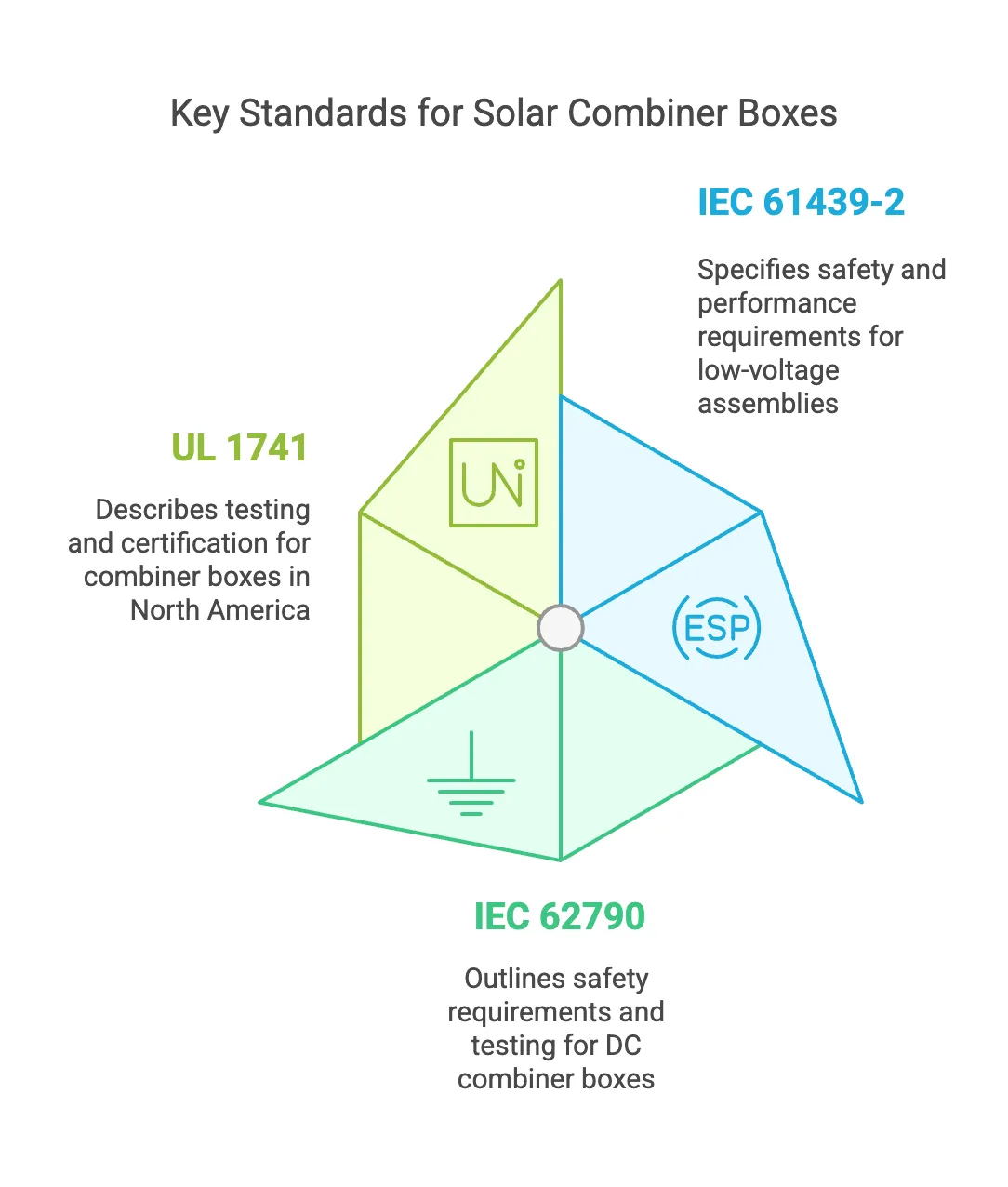
Key Standards for Solar Combiner Boxes
Quality assurance extends beyond basic compliance to encompass our comprehensive quality management system. Our products meet international standards while offering specialized solutions for OEM/ODM partnerships and distributor networks across emerging markets.
B. Product Range and Customization
Manufacturers offer a variety of standard solar combiner boxes with different input and output configurations. Common types include:
– Basic configuration
- 1 string
- 2 string
- 4 string
- 1 or 2 output optional
Basic configuration combiner boxes are mostly suitable for residential rooftop photovoltaic systems and are typically rated for 600V/1000V DC protection systems.
– Medium configuration
- 6 string
- 8 string
- 12 string
- 1 or 2 or 3 output optional
Medium configuration combiner boxes are often used for commercial rooftop photovoltaic systems or industrial ground-mounted power plants, and are usually rated for 1000V/1500V DC protection systems.
– Large configuration
- 16 string
- 24 string
- more string…
- output optional
Large configuration combiner boxes are suitable for large-scale power plants and are typically rated for 1500V DC protection systems. Due to the complexity of large-scale power plant projects, combiner boxes need to be designed and planned based on the project drawings.
– Customization
Manufacturers can customize combiner boxes to meet your photovoltaic project requirements, including the number of strings, voltage, and protective components. You can also choose to configure monitoring modules.
- Adjust the number of input strings and array capacity to meet the needs of different photovoltaic system designs.
- Select the appropriate electrical enclosure based on the environment where the project is located.
- Determine the appropriate project safety requirements and specify the use of specific fuses, slow-acting or disconnecting surge protectors, and disconnect switches.
There will be more detailed requirements for specific projects. It is important to choose an optimized solar combiner box manufacturer that offers a wide range of products and customization options to ensure that the photovoltaic combiner box is personalized to meet the technical and environmental requirements of the project.
C. Technological Innovation
Excellent DC combiner box manufacturers, with their wealth of experience and expertise in DC engineering, have developed several advanced technologies after thorough design and testing. These technologies provide higher safety for photovoltaic systems, enhancing their reliability and efficiency of the systems.
- Monitoring Device: Monitoring the status of each string, bus voltage, status of breakers and surge protectors, and the temperature of the enclosure.
- Rapid Shutdown Switch: Quickly cutting off voltage when the system needs maintenance or encounters a fault, ensuring safety.
- Arc Fault Circuit Interrupter (AFCI): It is a device designed to prevent fires caused by arc faults in wires. When an arc fault is detected, the AFCI automatically cuts off the circuit, reducing the risk of fire and enhancing electrical safety.
DC combiner box manufacturers continue to innovate to better meet the current photovoltaic industry’s needs for circuit protection.
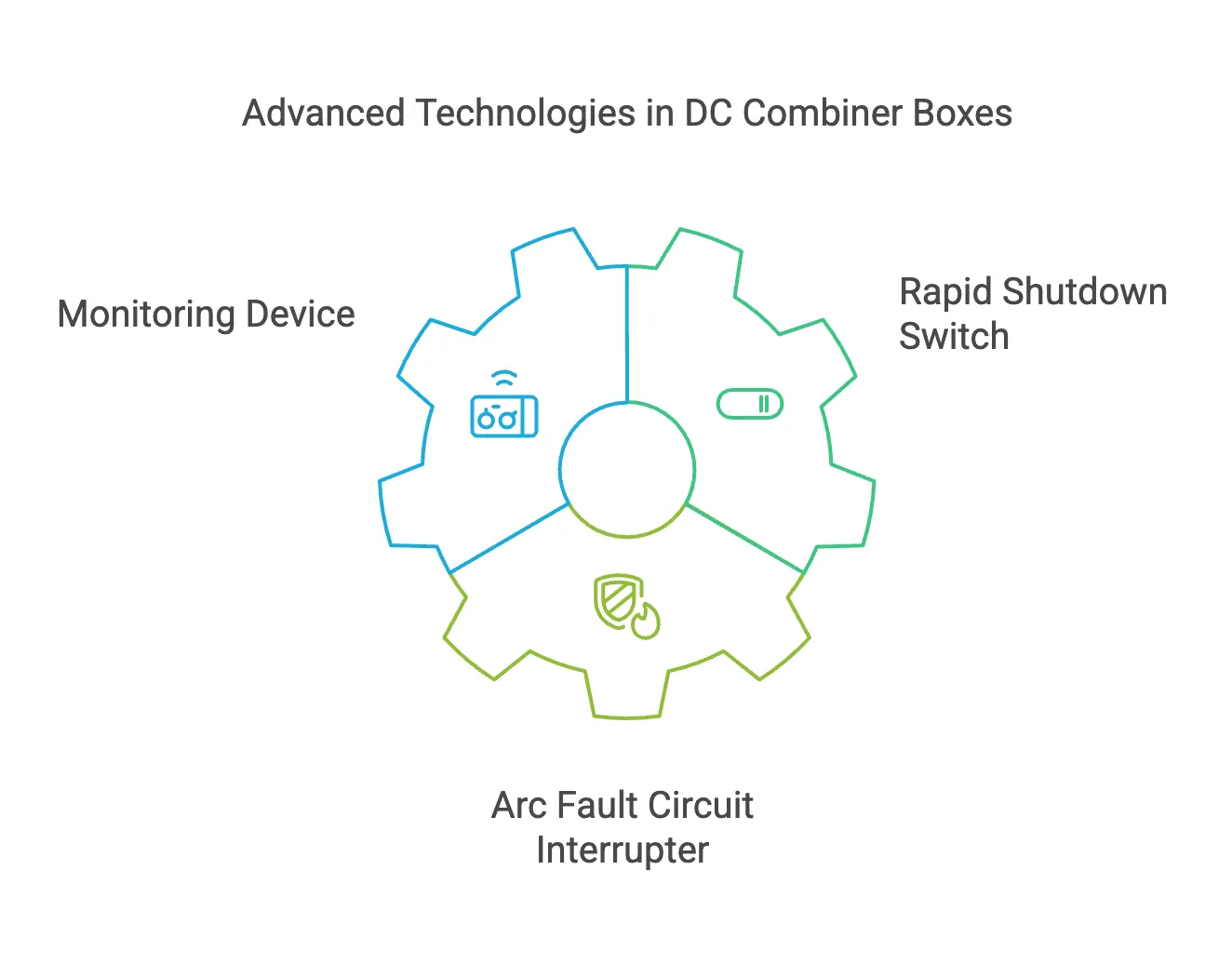
Advanced Technologies in DC Combiner Boxes
Our manufacturing capabilities span 600V DC residential systems, 1000V DC commercial systems and 1500V DC utility-scale installations. Specialized solutions include floating PV combiner boxes and high-altitude rated systems for challenging environments.
D. Reliability and Durability
DC combiner boxes are typically installed outdoors and exposed to sunlight. They are even used in harsh environments such as highlands, deserts, coastal areas, etc. The combiner boxes must meet the IP65 protection level, which is dustproof, waterproof, resistant to salt spray, and UV radiation. This ensures that the equipment can operate reliably over the long term under extreme temperatures, high humidity, salt spray, and UV radiation, and other harsh conditions.
Warranty terms and after sales support offered by the manufacturer also have equal weight. A comprehensive warranty covers a product for 2 to 5 years, reflecting confidence in its longevity.
E. Industry Recognition
When selecting a solar combiner box manufacturer, it’s important to keep in mind their market recognition. It means they have ensured that they offer quality and innovations. Manufacturers who obtain awards and certifications from reputable organizations have proved that they are following industry standards and they are, in fact, excellent.
As an example, LETOP has undergone a series of certifications, such as ISO 9001, ISO 14001 and ISO 45001, for its commitment to producing high quality solar components.
Manufacturers that have received such accolades are good for the industry to prioritize because they will provide confidence in the durability and performance of their solar combiner boxes.
Advanced protection technologies integrate seamlessly with our comprehensive range of electrical protection and control devices, ensuring complete system safety and performance optimization.
Avoid common pitfalls
To avoid common pitfalls, it is important to navigate when choosing a solar combiner box manufacturer.
– Technical Support
Choose a reliable supplier who can provide sufficient support when you face the complexity of projects. Although it may require a bit more cost, it is worth every penny.
– Focus solely on cost
Ignoring quality for the sake of low cost can damage performance and lead to higher maintenance costs. Investing in high-quality components can save expenses in the long run. Strive for the right balance between product cost and quality.
– Neglect after-sales service
After-sales service and technical support are equally important. Comprehensive after-sales service is needed for system maintenance and troubleshooting. Ensure that the manufacturer provides high-level support to maintain the stability of your solar energy business.
Focusing on product quality, technology, and after-sales support will lead to success and sustainability in the solar energy industry.

Manufacture selection
Conclusion
When searching for a reliable photovoltaic combiner box manufacturer, all factors are important to consider. Choosing a trustworthy supplier is crucial. As a photovoltaic combiner box manufacturer, LETOP offers a range of high-quality and customized solar combiner boxes. Welcome to contact us immediately to get the photovoltaic combiner box you need.
For immediate technical consultation and customized solutions, contact our engineering team. Explore our complete portfolio of PV combiner box components and discover why leading EPC contractors choose LETOP for their most challenging solar installations.
Professional FAQ: Selecting Solar Combiner Box Manufacturers
1. What manufacturing certifications should I verify when evaluating solar combiner box suppliers?
Answer: Essential manufacturing certifications include ISO 9001:2015 (Quality Management), ISO 14001 (Environmental Management), and ISO 45001 (Occupational Health & Safety). Product-specific certifications must include IEC 61439-1/-2 (Low-voltage switchgear assemblies), IEC 62790 (Junction boxes for photovoltaic modules), and regional certifications like CE marking for Europe, UL 1998 for North America, and TÜV certification for global markets. For RECP countries and emerging markets, verify CB scheme certification which facilitates acceptance across multiple countries. Additionally, ensure manufacturers maintain IPC-A-610 standards for electronic assembly and RoHS compliance for environmental regulations.
2. How can I assess a manufacturer’s production capacity and scalability for large utility projects?
Answer: Evaluate production capacity through multiple metrics: Annual output capacity (measured in units per year), lead time consistency (standard vs. rush orders), and concurrent project handling capability. Request detailed information about manufacturing floor space, automated production lines, and quality control stations. Verify their ability to handle batch sizes from 100 units (small commercial) to 10,000+ units (utility-scale). Assess supply chain resilience by reviewing their component sourcing strategy – manufacturers with diversified supplier networks and strategic inventory management demonstrate better scalability. Request reference projects of similar scale and timeline requirements, particularly in challenging markets like Sub-Saharan Africa or Latin America where logistics complexity is higher.
3. What quality assurance processes distinguish reliable manufacturers from generic suppliers?
Answer: Superior manufacturers implement 100% product testing protocols including incoming component inspection, in-process testing, and final assembly verification. Key quality indicators include: Automated Optical Inspection (AOI) for PCB assemblies, hipot testing at 2.5kV for 1000V systems, thermal cycling tests (-40°C to +85°C), and vibration/shock testing per IEC 62790 standards. Verify implementation of Statistical Process Control (SPC) and Six Sigma methodologies. Request access to test certificates and traceability systems – each combiner box should have unique serial numbers linking to component batch records. Advanced manufacturers provide Material Certificates of Compliance (CoC) and maintain 20% random sampling inspection protocols for batch validation.
4. How should I evaluate a manufacturer’s technical support capabilities for international markets?
Answer: Assess technical support through response time commitments (target: <4 hours for critical issues), multilingual support capabilities covering target markets, and local technical presence or partnerships. Evaluate their application engineering support – can they provide system-level design assistance, load calculations, and compliance guidance for local electrical codes? Review their training programs for installers and distributors, including certification courses and technical documentation quality. For remote markets (rural Africa, South America), verify availability of remote diagnostic capabilities, video consultation services, and local service partner networks. Request examples of their technical documentation including installation manuals, commissioning procedures, and troubleshooting guides in local languages.
5. What cost factors beyond unit price should I consider when comparing manufacturers?
Answer: Total Cost of Ownership (TCO) analysis should include: Shipping and logistics costs – manufacturers with optimized packaging can reduce freight by 30-40%; Customs and duty considerations – verify HS codes and preferential trade agreements; Inventory carrying costs – minimum order quantities and payment terms impact cash flow. Factor in warranty coverage (standard 2-5 years vs. extended options), failure rates (ask for MTBF data), and service accessibility. Hidden costs include re-certification expenses for design changes, obsolescence risks for components, and currency fluctuation exposure. For projects in emerging markets, consider local content requirements, technology transfer obligations, and potential countervailing duties. Request detailed cost breakdowns including materials, labor, overhead, and profit margins to enable fair comparisons.
6. How can I verify a manufacturer’s track record in challenging environmental conditions?
Answer: Request documented evidence of successful deployments in similar climatic conditions: Desert installations (UAE, Chile, Australia) demonstrating sand resistance and thermal cycling performance; High humidity environments (Southeast Asia, coastal Africa) showing corrosion resistance; High altitude projects (Andes, Himalayas) proving pressure differential handling and UV resistance. Verify accelerated aging test results including 1000-hour UV-B exposure, 85°C/85% humidity testing, and thermal shock cycling (-40°C to +85°C, 200 cycles). Review field failure data and root cause analysis reports from challenging deployments. Assess their material selection expertise – use of marine-grade aluminum alloys, UV-stabilized plastics, and conformal coatings for electronics. Request climate-specific design modifications such as enhanced ventilation for hot climates or heater elements for cold regions.